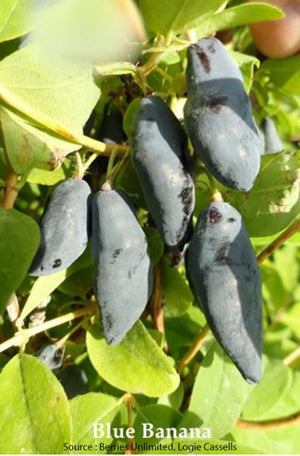
🫐 Honeyberry ‘INDIGO GEM’
Name: ‘Indigo Gem’
Type: Honeyberry / Mayberry
Botanical Name: Lonicera caerulea
Family: Caprifoliaceae
Origin: Canadian horticultural selection
🌿 The Plant
‘Indigo Gem’ is a variety of honeyberry particularly valued in cold regions. It is a deciduous, compact, and relatively easy-to-grow shrub.
It typically reaches around 1 to 1.5 m (3 to 5 ft) in height, with a similar width, making it an easy shrub to integrate into a fruit garden.
🫐 The Fruits
The fruits are elongated, dark blue berries when ripe, covered with a fine whitish bloom.
The flesh is juicy and has a sweet, fruity, and slightly tangy flavor.
An interesting characteristic of ‘Indigo Gem’ is its good quality for fresh consumption, but the fruits can also be used for:
- 🥧 Pies and desserts
- 🍯 Jams and jellies
- 🫐 Compotes
- 🥤 Smoothies
- ❄️ Freezing
- 🍨 Desserts and sauces
❄️ Hardiness
This is one of its greatest advantages! 🌨️
The honeyberry is extremely cold-hardy. ‘Indigo Gem’ is generally considered suitable for zones 2 to 7, making it an excellent option for much of Canada.
The plant can withstand very low winter temperatures.
⚠️ As with several very hardy fruit shrubs, however, spring flowers can be more vulnerable to late frosts than dormant branches.
🌸 Flowering
Flowering is very early in spring, with small yellowish flowers.
This is particularly interesting for pollinators 🐝, as the flowers appear very early in the season.
🐝 Pollination
A very important point with honeyberries:
👉 ‘Indigo Gem’ should not be planted alone if you want to maximize the harvest.
It is preferable to plant at least two compatible varieties that flower at the same time.
An excellent companion for ‘Indigo Gem’ is ‘Indigo Treat’.
Cross-pollination generally leads to more fruits and better harvests.
☀️ Growing Conditions
Honeyberries are relatively easy to grow.
They prefer:
☀️ Full sun for maximum production
🌱 Rich, well-drained soil
💧 Regular moisture
🍃 A location with good air circulation
However, they tolerate a wider range of soil and exposure conditions than many other small fruits.
✂️ Pruning
In the first few years, pruning is generally light.
Once the shrub is well established, old, weak, or crossing branches can be removed to maintain a good structure and promote new growth.
🫐 Harvest
‘Indigo Gem’ is an early variety, which is one of its main attractions.
The harvest usually comes in early summer, often before strawberries, raspberries, and many other small fruits.
The fruits turn dark blue when ripe, but be careful: the outer color does not always mean the fruit is perfectly ripe inside.
A ripe berry should be soft and have developed its full flavor.
⭐ Its Main Assets
‘Indigo Gem’ is primarily:
🫐 Excellent hardiness
❄️ A variety suitable for cold climates
🌸 Very early flowering
🐝 An early food source for pollinators
🫐 Flavorful and versatile fruits
🌱 An easy-to-maintain shrub
☀️ Good production in full sun
🍓 A very early harvest
🌟 In Summary
If you are looking for a very hardy, easy-to-grow, and early-producing small fruit, ‘Indigo Gem’ is an excellent choice.
Its main takeaway is truly cross-pollination: for a good harvest, I would pair it with another compatible flowering honeyberry variety, such as ‘Indigo Treat’. 🫐🐝
A little tip for Quebec: since the fruits ripen very early, you have to watch out for birds! 🐦😄 They often seem to discover honeyberries before we do.