


SCOUT apricot
Regular price
$45.00
Shipping calculated at checkout
Only 4 in stock
Need more? Contact us
This tree needs pollination
Compatible trees:
TILTON apricot SEMI-DWARF
TILTON apricot SEMI-DWARF
Origin & history
- ‘Scout’ is a hardy variety developed by the Morden research program (Manitoba, Canada) in 1937.
- It is also sometimes referred to as Scout Apricot/Prunus armeniaca ‘Scout’ or Prunus mandshurica ‘Scout’ in some sources.
Main characteristics
- Hardiness:
- Very good. Estimated hardiness zone between zone 3 (or even 2-3 according to some) and zone 4-9 depending on the source. Can withstand very cold winters.
- Flowering:
- Very early in spring. Pink then white flowers at the beginning of the season.
- Fruit
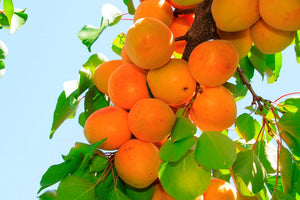
- Color: golden-bronze with sometimes a blush of red on the sunny side.
- Orange flesh.
- Freestone fruit (non-adherent pit).
- Quality: good for preserves, jams, canning, possibly good for eating fresh but often described as “fair” for direct consumption by some sellers.
- Harvest/maturity:
- Mid-summer, often in August depending on the region.
- Trees bear fruit from ~ the 2nd year after planting, with good production from the 3rd or 4th year.
- Size/habit:
- Medium to large depending on rootstock and conditions. Adult height often around 4-6 meters, similar moderate spacing.
- Moderate growth.
- Pollination requirements:
- Partially self-fertile, but significantly better yield if one or more compatible pollinators are nearby.
Advantages
- Very good resistance to cold, making it suitable for harsh climates (e.g., cold areas of Quebec, Prairies).
- Early flowering, which can be an advantage for extending the season.
- Good for processing (jams, preserves) and for “household” uses (harvesting, storage, etc.).
Limitations/constraints
- Although hardy, early flowering exposes the flowers to spring frosts—if these occur after budding, they can reduce the harvest.
- Dependence on a pollinator for better yields. With no other variety nearby, yields may be limited.
- Fair to good quality for eating fresh according to some sources—some prefer other sweeter or juicier varieties if this is the main use.
- Like all apricot trees, may be susceptible to certain diseases in humid climates or if there is insufficient sunlight/air circulation.
Hardiness Zones
Growth speed
Number of years for production
3 years

