


Chestnut 'Bouche de Bétizac'
Shipping calculated at checkout
66 in stock
Need more? Contact us
This tree needs pollination
Compatible trees:

Hybrid chestnut 'Marsol'
Hybrid chestnut 'Marsol'
Chestnut tree Marigoule zone 6a
Chestnut tree Marigoule zone 6a
Precoce Migoule Chestnut
Precoce Migoule Chestnut
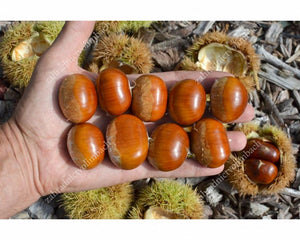
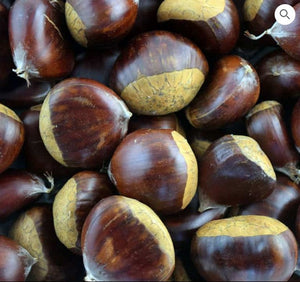
Bouche de Betizac' (C. sativa × C. crenata) is an open-pollinated seedling of the French cultivar 'Bouche Rouge' and a pollen relative of C. crenata. It was introduced to the United States by Craddock and Pellegrino (1992). Grafted trees have been widely planted in the western United States, but not in the Midwest. The tree has vigorous, upright growth. It tolerates the heat of California's Central Valley very well, but it also performs well in cooler climates. Nuts fall mid-season in warm climates. The 'Bouche de Betizac' is sterile in terms of pollen. It produces very large, dark brown nuts that peel well and have a good flavor. The ramets from the UMCA depot have a nut size ranging from 20 to 25 g. Three nuts are standard per strawberry (Nave, 1998). The nuts located in the center of the branches are generally flat. The variety 'Bouche de Betizac' presents field immunity against the Asian wasp (Torello-Marinoni et al., 2018). Grafted trees have been widely planted in the western United States, but not in the Midwest. 'Bouche de Betizac' plants were planted in the Midwest, but with moderate expectations because they were pollinated with C. sativa. Plant with Marsol, Marigoule or Precoce Migoule for pollination.
Chinese chestnut trees with European x Japanese hybrid chestnut trees is a pollen incompatibility that causes the hybrid nuts to rot. While Chinese chestnuts are resistant to chestnut blight, European x Japanese hybrids are susceptible, creating a further disease-related issue.
- Cause: A pollen incompatibility reaction between the two types of trees triggers the nut decay. For example, the cultivar 'Colossal'—a European x Japanese hybrid—can have up to 40% of its nuts affected by IKB when pollinated by a Chinese chestnut.
- Symptoms: This condition causes the nut kernels to rot internally, making the nuts unmarketable.
- Solution: Growers in Michigan and elsewhere are advised to plant either the European and Japanese hybrids together in an orchard or Chinese chestnuts in a separate orchard, but not to mix the two types in the same orchard
Hardiness Zones
Growth habit (tree shape)
Mature height
Mature width
Growth speed
Flowering period
Number of years for production
8 years
Harvest month
Light
Uses / Special remarks

