Skip to content
  • LAST DAYS TO ORDER FOR SPRING DELIVERY • After May 29, orders will be DELIVERED IN THE FALL • Nursery pickup still available
  • 🛒 Shipping ALL ACROSS CANADA available on orders of $50 or more before taxes. For smaller purchases, in-store pickup remains available! 🛒
Close (esc)

LAST DAYS TO ORDER FOR SPRING DELIVERY

Our final ordering period for spring delivery is now underway. Orders placed after May 29 will be delivered in the fall. Nursery pickup remains available by appointment.

To stay up to date, subscribe to our newsletter:

Precoce Migoule Chestnut

Regular price $13.50

Shipping calculated at checkout

Size

Out of stock

Need more? Contact us

Pollinators for this tree include Marigoule and Marsol.

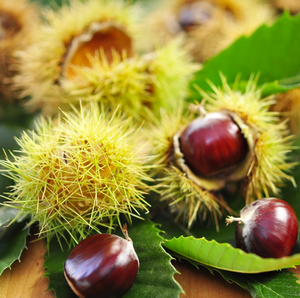
This natural cross of the European chestnut (Castanea sativa) and the Japanese chestnut (Castanea crenata) was discovered by J. Dufrenoy in a Migule orchard in Brive-la-Gaillarde, France. The walnut, which ripens early and excellently, is an excellent choice for cooler northern climates where it ripens reliably before frost. The flowers are also early and slightly sensitive to frost, but nuts also form on the secondary buds. Large nuts store well, have good to excellent flavor, are easy to peel, and drop from mid-September to early October without the bugs.

The trees are vigorous growers, gaining 3 to 5 feet per season and producing nuts between 7 and 9 years old, with full nut production between 12 and 20 years old depending on conditions. They are large trees, reaching 60 feet if conditions are ideal, with a wingspan of up to 30 feet. An excellent fresh nut variety, this tree will produce early, reliable harvests and provide excellent pollination for all Castanea sativa chestnut trees (European and European hybrids), including Colossal. Pollinators for this tree include Marigoule and Marsol.

The primary problem with interplanting

Chinese chestnut trees with European x Japanese hybrid chestnut trees is a pollen incompatibility that causes the hybrid nuts to rot. While Chinese chestnuts are resistant to chestnut blight, European x Japanese hybrids are susceptible, creating a further disease-related issue. 


Internal kernel breakdown (IKB)

Internal kernel breakdown (IKB) is a rot that occurs when European x Japanese hybrid chestnuts are pollinated by Chinese chestnut trees. 

  • Cause: A pollen incompatibility reaction between the two types of trees triggers the nut decay. For example, the cultivar 'Colossal'—a European x Japanese hybrid—can have up to 40% of its nuts affected by IKB when pollinated by a Chinese chestnut.
  • Symptoms: This condition causes the nut kernels to rot internally, making the nuts unmarketable.
  • Solution: Growers in Michigan and elsewhere are advised to plant either the European and Japanese hybrids together in an orchard or Chinese chestnuts in a separate orchard, but not to mix the two types in the same orchard

Hardiness Zones

  • 5a, 5b, 6a, 6b, 7a, 7b, 8a, 8b, 9a

Growth habit (tree shape)

  • Flared

Mature height

60 feet

Mature width

30 feet

Growth speed

  • Fast

Flowering period

  • July

Number of years for production

8 years

Harvest month

  • Mid-October

Light

  • Full-sun

Uses / Special remarks

resists burn and -28 ....-30 Celsius well.

IMPORTANT: We do not deliver trees 7' and taller! (Nursery pickup only).• ORDERS PLACED AFTER MAY 29, 2026 WILL BE DELIVERED IN THE FALL

Shopping Cart

Your cart is currently empty

Shop now